Saturday, September 20, 2014

Is Client Loyalty Dead, Part 2

Week of September 12, 2014
Last week, I shared some of my recent pondering about whether or not client loyalty (loyalty to us/our firms) was dead. I have concluded that clients are not really loyal to a company/firm, but to a particular person. So in that respect, no, loyalty exists. And it is a powerful one-to-one bond.

I've seen that manifested when a popular client manager leaves a company... and the clients follow him or her to their new firm. So what is that client manager doing to gain that respect and, well, loyalty?

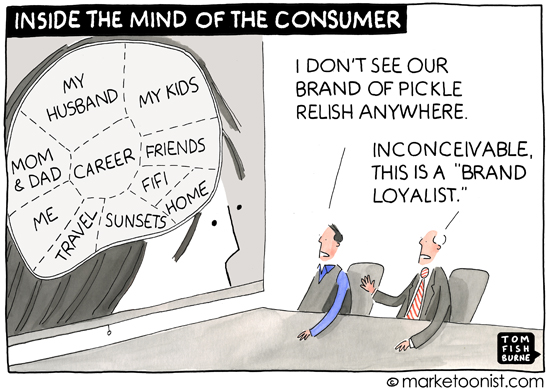
Interestingly, Tom Fishburne, The Marketoonist, has touched on this topic a couple of times. The reality is that clients are thinking about a lot of things, and we are probably not any of them. It is VERY much like this cartoon, "Inside the mind of the consumer" by Tom Fishburne.

This is just human nature. Clients, like all of us, have far more stuff going on in their brains than the name and services of a consultant.

Even clients who are loyal to us, who like us and come to us a lot, suffer from this "too much stuff on the brain" syndrome. For more on how the consumer/client thinks, read the companion article "Inside the mind of the consumer." It is vital to know what is on the client's mind before we can change our position within it.

Next week... how to get to the "top of mind" position with a client.

Tuesday, September 16, 2014

Is Client Loyalty Dead?

Week of September 8, 2014
I've been pondering this question a lot lately: Is Client Loyalty Dead?

Things keep floating up out of my subconscious in response, like when I worked for my father's law firm. He told me that clients, including managers of corporations and government officials, never liked being shifted from the attorney they were familiar with to another in the same firm. The client saw their primary relationship as being with the individual attorney, not the law firm. This was a particularly difficult issue in the large law firm in Portland where he first practiced because senior attorneys wanted the younger, less-expensive attorneys to do as much of the work as possible, which led to more profitability. And while clients may not have understood the motive, they certainly felt slighted if "their" attorney wasn't made readily available.

So maybe our thinking about loyalty is faulty -- that someone could be loyal to a firm/company. It follows that it is easier to establish and maintain a relationship with clients on an individual basis, not a firmwide or organizational one. 

What are we doing to create those relationships? 

I think that part of my role in marketing is to help identify the individual qualities of the person and then help select the technical individual who is the best match. Client research has to go beyond what can be read on the web or in a report. It is equally important to know as much about the individual client staff as it is to know about the organization, company, and market.

 It is a two-step process (at least): 1) Identify the clients and the people within that client organization who are most influential and figure out what makes them tick/what kind of people they are. 2) Then identify the strengths of your BD/Marketing team and match them up to the people at the client organization. 

If we want any semblance of loyalty, perhaps we need to look at how we approach our clients (and with whom) first. It is bringing the "friend making" to a conscious level, and pairing the "right" people together to create something extraordinary. 

I'm still pondering this... More next week...

Friday, September 5, 2014

Meaningful BD

Week of September 1, 2014
Wow, where did summer go? I have been getting a lot of business development questions lately, so I thought I would share some of the tips I've passed on to folks who have asked. Here are your Things You Need to Know for this week:

Question 1: How can I be most efficient with my few BD hours?
The short answer is: Talk to your clients. The longer answer is: Make those conversations with your clients meaningful for them. In general, your client is bombarded with requests to meet to talk about upcoming projects. They may get very little from those conversations. It might even be painful for them to take the time for those meetings because of other deadlines and their own workload. Put yourself in their shoes, and offer them something when you meet that they need/want/like. Here are some suggestions to provide meaning and engagement.

A) What does my client need to know right now to make their job easier, better, safer, smarter, more compliant, more efficient, etc.? Do I have that knowledge/resource available to share? Can I summarize it in 5-10 minutes and have a conversation about it with them? Can I bring an expert (from my company) with me to talk about that and to introduce the client to an additional company member?

B) What is my client's biggest concern/worry today? Would my client talk to me about it if I offered to listen without judgment or offering solutions? Can I be a good sounding-board for their issues, and take some time to offer a helpful solution at a later date (not offer a solution on-the-fly at the moment of the conversation)?

C) What do I have in common with my client outside of work? What committees/organizations are they involved with? Where can I help?

D) What does my client do for fun? Would my client go with me to try our a new restaurant I've heard about, but have not been to before? [Side note - sharing a low-risk adventure like a new restaurant/coffee shop can make some amazing memories and build instant rapport. And everyone needs to eat...]

E) What am I working on right now that would be of interest to my client? If I took them to the job site, what would I point out? Or if I brought them to the office, who would I introduce them to and why?

F) What funding sources are available for my client's type of work/projects? What information could I find to share with them? What services could I offer to help them secure the funding?

Question 2: I don't have a lot of interaction with the decision-makers. Where can I help?
Short answer: Keep your ears open. Long answer: The people you work with at the client and on the team are"in the trenches." They may not know what is coming down the road, but they know what they are worried about, the rumors, and the whispers. Pay attention to what they say and share that with your marketing/BD folks. Similarly, some of the consultants you work with on a regular basis can become your company's best teaming partners. You can help your company make an assessment on which firms might be a good fit.

Question 3: I think my client wants us to work on a project, but they feel obligated to put it out for open competition. Is there anything we can do to get a direct appointment?
Short answer: Get smart on Quality Based Selection (QBS) and the contracts your company has in place already that the client might be able to use. Long answer: Many states, like Oregon and Washington, have a QBS process which emphasizes firm qualifications instead of price as the selection criteria. More importantly, the QBS system often allows the public entity to direct appoint projects up to a certain dollar cap to firms already "pre-qualified." Your public client/project managers might not be aware of that, so it is an excellent piece of information to know (confirm it is true for your state!) and have ready to share.

Additionally, your company may already hold a contract that your client can draw from, using whatever procurement system is available for them. For example, you might be a subconsultant on a multidisciplinary team. Your client might not realize that they can access you through that team's contract. Often, clients can use an on-call contract to direct appoint projects up to a certain dollar amount. For other projects that are too large to direct appoint, they can select a few folks from the on-call to compete for the project, instead of holding an open competition.


I hope these help you interact in meaningful ways with your clients. Your strategies in pursuing work are only as good as your knowledge, so talking with your clients is always a good thing. And please be sure to share your information with your marketers/BD folks. They can often "connect the dots" internally between projects, people, and clients.

Make it a GREAT week!


Wednesday, August 27, 2014

Internal Proposal Process

Week of August 25, 2014
Good morning, BD/Marketing campers! Today's blog is "farm fresh," as they say. I just messed up. The proposal I was working on arrived at our office on time this morning for delivery to the client, but printed double-sided (should have been single-sided), and with one form unsigned. Marketers out there -- is your stomach turning??

These errors could have been prevented with more time for QC and a compliance check on the last day. Instead, we were adding text and new graphics, and receiving edits from multiple reviewers on the same day the proposal was to be printed and sent to another office for delivery. I knew better, and I did it anyway. 

I'm sharing my preventative tips. I normally do these, and my proposal process is (usually) smooth, efficient, and relatively painless. This time I did not follow my own process, and mistakes were made. It was an important reminder: no matter how much experience you have with proposals, there are no shortcuts.

Here are your Things You Need to Know (or Remember) about leading a proposal-writing process.

1) Go through the RFP and create your own outline. Include:

  • The order and section titles
  • What must be in each section
  • Page limits for each section (if any)
  • Points/value of each section
  • Criteria of each section
  • Who will write what (by section or item, as appropriate)
  • Required forms, who will sign

2) Create the envelope labels/transmittal sheet on the first day and store them in your proposal folder.

3) Write on the front of the folder or RFP in BIG LETTERS the printing instructions, e.g. how many pages,  whether it is single or double-sided, bound/unbound, originals/copies. Add this to your outline, too.

4) Prepare a proposal-writing schedule that looks like a typical calendar month. The visual of a calendar page helps the team grasp the deadlines quickly. Include:

  • Graphics - sketches due, mock-ups due, edits returned, revisions due
  • Quals/resumes - drafts out, edits returned
  • Subs' materials due
  • Forms signed/added to proposal
  • Draft narrative due, who reviews, revisions due
  • Final narrative due for proposal compilation
  • Draft proposal out - who reviews, revisions due
  • 2nd draft proposal out - who reviews, revisions due
  • Ample time for a quality control/compliance check (usually by marketing)
  • Production, delivery time
  • Proposal due date -- who delivers
  • Vacations/out-of-office of proposal contributors

5) At the proposal kick-off meeting, review the outline AND schedule. Make adjustments; resend. Follow the schedule. Missed an internal proposal-writing deadline? Follow your company's protocol. At the very least, call the team members involved and hash it out. Exactly as with a project, every missed deadline or piece of information has a ripple effect. 

6) Debrief with the proposal-writing team after the proposal goes out, and before a decision has been made. What went well? What didn't work? What can be done next time?

My proposal schedule sample is below. Can you spot the missing information? What would you have done differently, now that you have seen my usual process above?


In case you were wondering, the office is re-printing and hand-delivering the proposal. It should be ok in the end. Although, my stomach is still upside down. As my mentors say, "Breathe deep, accept the situation, change what you can, and move on."
Make it a great week!
K

Friday, August 22, 2014

Writing Guidelines

Welcome to the inaugural post of my BD and Marketing Blog for Professional Marketing Services. Consider this a "note from a friend." Each week, I'll post articles that interesting, informative, or important to your jobs. I will also take you behind the curtain of marketing/BD for professional services, to keep you educated and motivated in your client relations. And I will try to give you a glimpse inside my brain at the odd and sometimes amazing connections that are made there. [You don't have to be crazy to love marketing, but it helps!]

So, "Hi!" to everyone. Drop me a line sometime to let me know how you are doing, what you need, and what you are up to. The Blog is for YOU - please help me give you what you need/want to see. Until then, here are the Things You Need to Know for this week.

Just as you all have to follow standards and guidelines in submitting your deliverables to various clients and agencies, marketing and BD has standards and guidelines. Most companies have writing, style, and graphics guidelines specific to their company, or have adopted a particular edition of the AP Style guide. In either case, get to know your company's practices. Following them not only makes editing easier, it gives a consistency to your company's materials that clients recognize and appreciate.

Here are a couple of items that tend to trip us up:

Capitalization - avoid unnecessary capitals. Proper names and formal titles are capitalized when used as the name and title; almost everything else is not. If someone served as the project manager, then it is not capitalized. If they are Project Manager Jane Smith, then it is capitalized. In the case of reports, an environmental assessment is not capitalized, but the Lower Stanton River Environmental Assessment is capitalized, as it is the formal title of the report.

Acronyms - Acronyms and abbreviations for government agencies should be spelled out the first time they are used in the document. Several companies use ONLY the acronym in their employees' resumes and the project descriptions, because it is likely that the acronym would be used (and spelled out) MUCH earlier in a proposal document than the resumes/projects. This is a time-saving practice!

In the case of technologies that are widely recognized by their abbreviation, use that in all references: GPS, GIS, CADD, JPEG, PDF, etc.

Agencies commonly known by their acronym can be used with or without first spelling them out (FEMA, NOAA, EPA, DoD, etc.) These could be regional, as well, such as CDOT in Colorado -- you would not need to spell out CDOT in a CDOT submittal.

Numbers and dimensions/units - Spell out numbers under 10... except as part of dimensions, distances, or addresses. For example, "He has more than six years of experience..." but "he built a 16-by-9-inch box." All unites are spelled out (inches, feet, foot-long, percent, etc.), without the use of symbols (no ", ', or %). If the number begins a sentence, spell it out.

Ensure/Assure/Insure - these words, and all of their forms, are liability words that should be avoided. They implay a guarantee of action or result, which you might not fully control. Rewriting the sentence that has any of these words in it usually involves identifying an action or desired result and focusing on that. For example, "We will perform quality checks prior to each submittal to ensure they comply with ODOT standards," would become "We will perform quality checks to confirm compliance with ODOT standards." Or better: "We will check that deliverables comply with ODOT standards."


What are your common standards/guidelines? Or pet peeves?

Make it a great week!