Showing posts with label business development. Show all posts

Wednesday, October 22, 2014

Get a Meeting

Week of October 20, 2014
This week is about getting a meeting with your clients. How do you get that next "touch point" so you stay Top of Mind? Here are my 10 quick tips.

1) At the end of your project-focused discussion, ask the client what else they have on their plate OR how else you can be of help to them. Be sincere, and this one question can uncover a wealth of opportunities.

2) Arrange a site visit to a current project, a project-of-interest to the client that you are doing, or an open tour that you know about.

3) Introduce your client to a colleague, trusted subconsultant, industry expert, or teaming partner.

4) At a project milestone, thank them for their business and support on the project; congratulate them on meeting the important milestone (on schedule or ahead of schedule or under budget).

5) Offer to collaborate with the client on an article, a presentation, an award submittal, etc. Do your homework and find an appropriate venue/audience for what you propose.

6) Ask for feedback - how are you doing on the job? how can you improve?

7) Reality check - ask the client "What is going well?" Not everything is a problem to be solved. Help them (re)gain some perspective with this game-changing question.

8) Share industry news, an economic forecast, and/or technology advancement. They probably do not have time to keep up-to-speed on the latest/greatest, so help them out by bringing something you found interesting or helpful to their attention. Be sure to discuss with them WHY you found it interesting/helpful.

9) Take your marketer to meet your client. We need to know about them, too, and what better way than to meet them and help generate conversation? We can ask them the "big picture" questions that might not come up naturally in your usual conversations, such as trends, economic outlook, or organizational news.

10) Still need ideas? Check out these two items from the Oregon Daily Journal of Commerce: What does your client want (a synopsis from a keynote speaker at the Society of Marketing Professional Services Pacific Regional Conference) and What does the client want? (an article I wrote for the Journal with information straight from the clients' mouths).


Tuesday, October 14, 2014

What Will It Take to Win This Job? Part 2

Week of October 6, 2014
Last week, I shared my tip for making a compelling argument to hire your company for that super cool job: writing an executive summary in advance of the RFP.

So you have written it. It is well before the RFP has come out. You avoided complex vocabulary. You were clear and succinct. But your reviewer says it is lacking in specifics. What does that mean? And how do you fix it?

Remember how your executive summary was organized?
  1. Client Needs - spell out what the client needs and the client's key issues or problems, based on what the client has told you
  2. Results/Benefits - what the client wants to achieve by addressing their issues or solving their problems. These could also be the benefits the client will realize through the completion of the project, such as safer streets, fewer community complaints, good publicity, etc. This must be based on what the client has told you, too.
  3. Solution(s) - what will you DO that will (lead to) the solution for the client's problems and deliver the results the client wants? This has to be action-oriented, explaining the process, not the products. The products will be the same for every competitor. Only the process, the experience the client will have working with you, will be different. Pick out the high points, as if you are opening the "black box" of your creative process.
  4. Proof - briefly explain where you/your company has provided a similar solution/process, and how it was received. This can be as brief as a single sentence: "We implemented a similar collaborative process for the City of Wonder, and they were able to complete their project three months ahead of schedule with full Council approval and an overflowing community ribbon-cutting ceremony."
The number one problem with poor executive summaries is that they are not client-focused. What your reviewer is telling you is that your executive summary talks too much about you/your company, and not enough about the client, or looking at things from the client's perspective. So how do you get that? You're already written everything you know.

Right. What YOU know. Based on what? Who told it to you? Or did you make some well educated guesses?

Here's the solution in three parts:
Ask more questions.
Talk to different people.
Test what you think you know.

ASK MORE QUESTIONS
I could write several blog entries on this alone. (And I probably will...) In general, we ask far too few questions. The rule of thumb when you are talking with a client is that you listen 80 percent of the time and talk 20 percent. Ask a question and listen to the answer. Don't formulate your next question while you are listening. Do not bombard them with a million questions, or try to get through your "list" before the meeting is over. Don't try to solve their problem while they are talking. Just let them talk. Let the conversation go wherever it does. And let there be silence! If you just look at them expectantly in the silent parts, your client will likely keep talking. If they do not say anything else, say "Could you tell me more about..." and pick one or two words from what they said. That will get them going again. Take someone with you - to take notes, ask questions from a different perspective, and watch the client's body language. Each of you will remember different elements and have completely different "reads" of the conversation. 

Not sure what to ask? Start with, "I know we've talked about this project before, and I have many of the specifics. But can you tell me what is driving this project? Why is it coming up now?" 

And after that, try, "What are YOU thinking about the project? Is there anything that you think might cause you concern or grief? Or anything that could make things go really smoothly?" See where those take you.

End the meeting with, "And who else do you think I/we should talk to about this project? Who else has a stake in it? Or an opinion about it?" 

Get names. And be gracious, thanking the client sincerely for sharing their thoughts and time.

TALK TO DIFFERENT PEOPLE
Your client gave you other names, either of people within their organization or with stakeholders, who have an interest in the project. Meet with them. Ask them why they are interested in the project. Ask them what it means to them. Ask them the same questions you asked your client - you will likely be surprised how much stakeholders have to say about the technical side of projects. Listen for things beyond the technical, too. What is at stake for the stakeholder(s)?

Ask them who else you should be talking with. Get names. Follow-up.

TEST WHAT YOU THINK YOU KNOW
When you start hearing the same items from different sources, you have likely hit upon a real issue/key element of the project. For example, different stakeholders and the client might say that public opinion is going to be a factor. Perhaps there are certain special interest groups that may come in to play over one or two elements of the project. Test that. 

Write the few items you believe are key onto separate note cards. Take a few blank ones.

Go back to the client/project manager and say, "We've heard from you and others that these elements are key to the project succeeding. Either they must be overcome, or they must be enhanced/brought about. Would you look at these and tell us if we have captured the information accurately?"

"Have we missed anything or mis-stated anything?" Pull out the blank note cards and add what the client adds. Let the client adjust wording on the note cards (you have a copy of your original back at the office anyway, right?)

"Could you prioritize these elements for us, from your perspective?" Let the client move the note cards around.

If they added cards, ask about those items. For whom are those items important? What has to happen to make this work?

And feel free to take the cards (revised by the client; cleaned up a little by you) to the other stakeholders, and see where they agree/disagree - either on content or priority.


Now, you can rewrite your executive summary.

Ok, obviously, this is a very quick overview of the process of digging deeper with your client and stakeholders. As I said, I could write several blog entries about this topic. But in brief, with the additional information you gather, you should be able to rewrite your executive summary to one that is focused on the client, clearly explains the results and benefits of the project (if everything goes as planned), and concisely explains exactly what your company can/will do to bring everything together. 
For detailed help with your client and stakeholder discussions, ask your marketers/BD professionals. They have access to many resources and seminars. Or hire an outside consultant, like Go! Strategies, LLC or any of my professional colleagues. We can help you tailor your approach, analyze what you learn, and develop your strategy to win. The super cool jobs are out there. Winning them takes time, persistence, and a stellar, client-focused executive summary. 

Thursday, October 2, 2014

What Will It Take To Win This Job? Part 1

Week of September 29, 2014
How many times have you heard (or thought) "What do I have to do to work on this project? This would be so cool!" And where does that conversation go? Into the weeds, as I like to say. That is, into the details about the project, the technical "coolness" of it, and the possible solutions.

My job at that point is to say, "We wouldn't be talking about this opportunity if you couldn't DO the work. What we have to do now is WIN the work." I'm such a buzz kill. But it's true. Why torture yourself with the fun talk about the project when you don't even have it, yet?

I think it is because folks believe that it is hard and not fun to do what is necessary to win the work. Let me tell you what "hard and not fun" is:

Hard and Not Fun

  • Writing a persuasive cover letter without knowing what is motivating the client
  • Tailoring resumes without knowing what skills the client is looking for or what is needed for the project
  • Putting forth a passionate, believable, likable PM that has never met the client face-to-face
  • Creating a team of subconsultants without knowing if any of them have history with the client (you know what I mean)
  • Knowing that our competition did all the previous phases of work, but not knowing if the client liked it or not
  • Writing an approach for a project that you understand technically, but not politically


Easy and Fun

  • Knowing more than any of your competitors about the project
  • Knowing what the client is really after because they told you
  • Being told by the client which subconsultants they think are needed for the project
  • Getting confirmation from several stakeholders that a specific issue is a real issue for the success of the project
  • Learning that your competition did not even bother to submit a proposal because they heard how prepared you were
  • Or even better - the client asks if they can sole-source the first phase of the project because they are so impressed with what you know and how involved you have been to this point!

What will it take to get to "easy and fun" and win the job? Do this ONE THING: Write an executive summary to your proposal before the RFP is ever released.

Organize your summary like this:

  1. Client Needs - spell out what the client needs and the client's key issues or problems, based on what the client has told you
  2. Results/Benefits - what the client wants to achieve by addressing their issues or solving their problems. These could also be the benefits the client will realize through the completion of the project, such as safer streets, fewer community complaints, good publicity, etc. This must be based on what the client has told you, too.
  3. Solution(s) - what will you DO that will (lead to) the solution for the client's problems and deliver the results the client wants? This has to be action-oriented, explaining the process, not the products. The products will be the same for every competitor. Only the process, the experience the client will have working with you, will be different. Pick out the high points, as if you are opening the "black box" of your creative process.
  4. Proof - briefly explain where you/your company has provided a similar solution/process, and how it was received. This can be as brief as a single sentence: "We implemented a similar collaborative process for the City of Wonder, and they were able to complete their project three months ahead of schedule with full Council approval and an overflowing community ribbon-cutting ceremony."


Have someone else read your summary. Ask them to look for:

  • Client Focus - does the writing focus on the client, the client's needs, how the client will benefit, how the solution(s) will help, etc.? This is good. If it strays to language about you/your company before the last paragraph, it will need to be corrected.
  • Filler - words like unique, state-of-the-art, cutting-edge, innovative, and others that are vague and/or superlative. These will need to be eliminated.
  • Jargon - The executive summary needs to be clean and simple so that anyone with a fourth grade reading ability can grasp what you are saying. Look for acronyms, technical jargon, etc.
  • Pretense - words and sentences that are more complicated than they need to be to convey the message need to be cleaned up. Remember, fourth grade reading ability. Do not hide your message in complex sentence structures or difficult vocabulary.


If the writing is clear, clean, and client-focused, you're in great shape! You know enough to make the proposal process much easier and more fun. If not... Come back next week for my tips on what you need to do next.

Thursday, September 25, 2014

Gaining Client Loyalty

Week of September 22, 2014
Ok, so how DO we get to top of mind and build client loyalty?

Interestingly, Tom Fishburne spoke on this very thing at his Google keynote, "Marketing Worth Sharing." At the link to his keynote, he includes both his slides AND his notes. You can easily follow what he is saying, and in essence, his message is this (and I agree):

When you're with your clients, how can you make their experience a little more awesome? THAT is marketing, branding, business development, client services, and company culture all rolled into one. Are you seeing it?

More importantly, are you hearing it? What are the things your clients are talking about? What are they wrestling with? When they share this with you, are you giving them your full attention? Or are you thinking about what you are going to say next? Or what service you want to tell them about?


For the next few days, I want you to try something for me... BE PRESENT.

When the client speaks, stop what you are doing and thinking, and really listen to what they are saying. Ask for clarification. Ask for details. Ask them how it makes them fell. Ask them what they want to accomplish. Ask them what "it" would look like if "it" was working/running/behaving the way "it" was supposed to.

Do not try to solve their problem. Don't offer your advice. And don't tell them about what your firm can do about that or the project you did that was just like what they are going through. Just help them be more awesome. Listen. Reflect back what they say. BE PRESENT.

Saturday, September 20, 2014

Is Client Loyalty Dead, Part 2

Week of September 12, 2014
Last week, I shared some of my recent pondering about whether or not client loyalty (loyalty to us/our firms) was dead. I have concluded that clients are not really loyal to a company/firm, but to a particular person. So in that respect, no, loyalty exists. And it is a powerful one-to-one bond.

I've seen that manifested when a popular client manager leaves a company... and the clients follow him or her to their new firm. So what is that client manager doing to gain that respect and, well, loyalty?

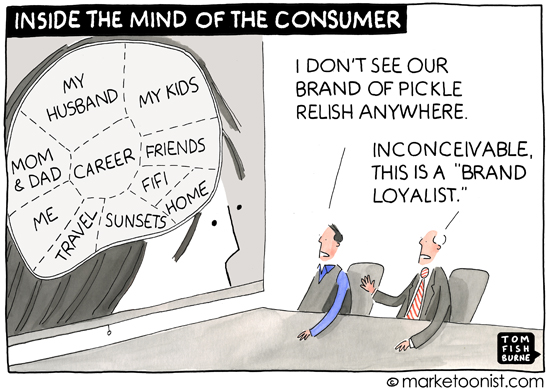
Interestingly, Tom Fishburne, The Marketoonist, has touched on this topic a couple of times. The reality is that clients are thinking about a lot of things, and we are probably not any of them. It is VERY much like this cartoon, "Inside the mind of the consumer" by Tom Fishburne.

This is just human nature. Clients, like all of us, have far more stuff going on in their brains than the name and services of a consultant.

Even clients who are loyal to us, who like us and come to us a lot, suffer from this "too much stuff on the brain" syndrome. For more on how the consumer/client thinks, read the companion article "Inside the mind of the consumer." It is vital to know what is on the client's mind before we can change our position within it.

Next week... how to get to the "top of mind" position with a client.

Tuesday, September 16, 2014

Is Client Loyalty Dead?

Week of September 8, 2014
I've been pondering this question a lot lately: Is Client Loyalty Dead?

Things keep floating up out of my subconscious in response, like when I worked for my father's law firm. He told me that clients, including managers of corporations and government officials, never liked being shifted from the attorney they were familiar with to another in the same firm. The client saw their primary relationship as being with the individual attorney, not the law firm. This was a particularly difficult issue in the large law firm in Portland where he first practiced because senior attorneys wanted the younger, less-expensive attorneys to do as much of the work as possible, which led to more profitability. And while clients may not have understood the motive, they certainly felt slighted if "their" attorney wasn't made readily available.

So maybe our thinking about loyalty is faulty -- that someone could be loyal to a firm/company. It follows that it is easier to establish and maintain a relationship with clients on an individual basis, not a firmwide or organizational one. 

What are we doing to create those relationships? 

I think that part of my role in marketing is to help identify the individual qualities of the person and then help select the technical individual who is the best match. Client research has to go beyond what can be read on the web or in a report. It is equally important to know as much about the individual client staff as it is to know about the organization, company, and market.

 It is a two-step process (at least): 1) Identify the clients and the people within that client organization who are most influential and figure out what makes them tick/what kind of people they are. 2) Then identify the strengths of your BD/Marketing team and match them up to the people at the client organization. 

If we want any semblance of loyalty, perhaps we need to look at how we approach our clients (and with whom) first. It is bringing the "friend making" to a conscious level, and pairing the "right" people together to create something extraordinary. 

I'm still pondering this... More next week...

Friday, September 5, 2014

Meaningful BD

Week of September 1, 2014
Wow, where did summer go? I have been getting a lot of business development questions lately, so I thought I would share some of the tips I've passed on to folks who have asked. Here are your Things You Need to Know for this week:

Question 1: How can I be most efficient with my few BD hours?
The short answer is: Talk to your clients. The longer answer is: Make those conversations with your clients meaningful for them. In general, your client is bombarded with requests to meet to talk about upcoming projects. They may get very little from those conversations. It might even be painful for them to take the time for those meetings because of other deadlines and their own workload. Put yourself in their shoes, and offer them something when you meet that they need/want/like. Here are some suggestions to provide meaning and engagement.

A) What does my client need to know right now to make their job easier, better, safer, smarter, more compliant, more efficient, etc.? Do I have that knowledge/resource available to share? Can I summarize it in 5-10 minutes and have a conversation about it with them? Can I bring an expert (from my company) with me to talk about that and to introduce the client to an additional company member?

B) What is my client's biggest concern/worry today? Would my client talk to me about it if I offered to listen without judgment or offering solutions? Can I be a good sounding-board for their issues, and take some time to offer a helpful solution at a later date (not offer a solution on-the-fly at the moment of the conversation)?

C) What do I have in common with my client outside of work? What committees/organizations are they involved with? Where can I help?

D) What does my client do for fun? Would my client go with me to try our a new restaurant I've heard about, but have not been to before? [Side note - sharing a low-risk adventure like a new restaurant/coffee shop can make some amazing memories and build instant rapport. And everyone needs to eat...]

E) What am I working on right now that would be of interest to my client? If I took them to the job site, what would I point out? Or if I brought them to the office, who would I introduce them to and why?

F) What funding sources are available for my client's type of work/projects? What information could I find to share with them? What services could I offer to help them secure the funding?

Question 2: I don't have a lot of interaction with the decision-makers. Where can I help?
Short answer: Keep your ears open. Long answer: The people you work with at the client and on the team are"in the trenches." They may not know what is coming down the road, but they know what they are worried about, the rumors, and the whispers. Pay attention to what they say and share that with your marketing/BD folks. Similarly, some of the consultants you work with on a regular basis can become your company's best teaming partners. You can help your company make an assessment on which firms might be a good fit.

Question 3: I think my client wants us to work on a project, but they feel obligated to put it out for open competition. Is there anything we can do to get a direct appointment?
Short answer: Get smart on Quality Based Selection (QBS) and the contracts your company has in place already that the client might be able to use. Long answer: Many states, like Oregon and Washington, have a QBS process which emphasizes firm qualifications instead of price as the selection criteria. More importantly, the QBS system often allows the public entity to direct appoint projects up to a certain dollar cap to firms already "pre-qualified." Your public client/project managers might not be aware of that, so it is an excellent piece of information to know (confirm it is true for your state!) and have ready to share.

Additionally, your company may already hold a contract that your client can draw from, using whatever procurement system is available for them. For example, you might be a subconsultant on a multidisciplinary team. Your client might not realize that they can access you through that team's contract. Often, clients can use an on-call contract to direct appoint projects up to a certain dollar amount. For other projects that are too large to direct appoint, they can select a few folks from the on-call to compete for the project, instead of holding an open competition.


I hope these help you interact in meaningful ways with your clients. Your strategies in pursuing work are only as good as your knowledge, so talking with your clients is always a good thing. And please be sure to share your information with your marketers/BD folks. They can often "connect the dots" internally between projects, people, and clients.

Make it a GREAT week!